Fixing Fights

Fixing Fights
M. Abduh

Former champions, current fighters, trainers, & analysts agree: Haney – Lomachenko was a good fight. A close fight. Some scored it for Haney by a round or two, some for Loma by a round or two. Many scored it a draw. Several rounds hinge on a few punches. That said, the decision was no robbery.

Casual fans seem unaware of the old boxing maxim: the challenger must either score a decisive victory or a knockout to take the belt. Before Chuck Hull announced the winner of the 1987 Sugar Ray Leonard – Marvelous Marvin Hagler middleweight championship fight, I said to my father, “Sugar won that.” My father tersely reminded me, “Close fight goes to the champ.” Either way, no one was robbed, not Hagler, not Lomachenko. No doubt, judge David Moretti’s score of 116-112 (eight rounds to four) caused a maelstrom. Giving Haney the 10th was abominable. Loma dominated the round. But even if Moretti rightfully gave it to him, it would still have been 115-113 for Haney. & still…a unanimous decision.

Casual fans (& apparently a few ‘hardcore’ ones) seem to know little about how rounds are scored.

“Loma was the aggressor,” they say.

There are two issues with this statement: First, it’s a half-truth. If one watches the fight closely—free of fan bias—he will see that the bout was full of ebbs & flows. At times, Loma aggressed. At times, Haney assailed. Second, simply being the aggressor does not mean a fighter wins the round. The aggression must be effective, which means a fighter lands clean, hard punches & avoids being countered. Several of Loma’s “flurries” were either blocked by Haney’s gloves or answered. Thus, most rounds were swing rounds, not beatdowns. (Even Shakur Stevenson was forced to change his fight night analysis. After reviewing the bout several times, he concluded it was much closer than he originally thought.) Judges also score points for ring generalship: the fighter’s ability to control the squared circle & impose his will & style on his opponent. Again, both Haney & Loma took turns imposing their wills—round-by-round. Likewise, judges look for hard & clean punches. “Loma was snapping Haney’s head back!” says the casual fan—while Haney was punishing Loma’s rib cage. Body punches may not be as sensational as headshots, but they can certainly be just as “hard & clean.” As the uncrowned champion Sam Langford once told Joe Louis, “Kill the body, & the head will die.”

***

Undoubtedly, boxing has judging troubles. Fight experts have forever declared this from the rooftops. But what is the solution? Boxing commentator Max Kellerman has a viable answer:       

As I mentioned at the beginning of this week, boxing has a scoring problem. I’m not talking about criteria. That’s easy enough. During each round, just ask yourself who you’d rather be. By the end of the round, you’ll know who to score it for. The problem is by how much.

Boxing is scored on what’s called the ten-point must system. The winner gets ten, & the loser always gets nine just about, unless he’s knocked down, then he’ll get eight. You almost never see a ten-eight round without a knockdown. So, you might see one fighter win a round big, & the other barely eke out the next one. Then after two rounds, the fight’s even, even though common sense tells you otherwise. Imagine a football game where one team wins the first quarter by a touchdown. The other wins the second quarter by a field goal, & somehow, they’re tied at the half as a result of that.

So how do we get to scorecards to better reflect the actual fight? Here it is. Don’t score all the rounds the same. You have ten points, right? Very close rounds are ten-nine. Decisive rounds, meaning you feel confident that one fighter or the other actually won, are ten-eight. Lopsided rounds, ten-seven. If a fighter’s knocked down, deduct two points. Knocked down twice, another two points. Touchdowns, field goals, two-point conversions, & extra points are not all scored the same, & neither should rounds in boxing be. We have ten points in the ten-point must system. Let’s use them.

Additionally, sportswriter Dan Rafael argues that judges need 

[T]raining, training, training. The key to me is that judges need to score fights on criteria that is more specific than it currently is & that fighters are also aware of what the judges are specifically looking for, so there can be no complaints. Right now, the criteria are a bit open-ended & not specific enough: ring generalship; clean, hard punching; effective aggression; defense. 

I agree with both men & have said so for years. Whatever can be done to correct the problem must be done. Posthaste. Meanwhile, not every decision is a robbery. Haney – Lomachenko, in particular, doesn’t even amount to petty larceny.  

De La Soul is Risen

De La Soul Is Risen
M. Abduh

I was lying on my cousin’s couch when the “Me, Myself, I” video came on. After telling everyone in the room to be quiet, I watched Plug One & Plug Two drop over a Funkadelic sample. Cuz’s floor model TV was old, so the picture was a menagarie of green, orange, & blue figures. But even if it had been in black & white, it was easy to see that De La Soul were originals, different than anything in hip-hop. They wore Dayglo prints and African medallions, not shoe-laceless shell tops or dookie ropes. (In fact, the video parodied that “false disguise of showbiz.”) They rapped about daisies, not Mercedes. From watching that first video to later buying every vinyl record, cassette tape, & CD they dropped, I became De La to the death (or at least until they broke up).

Death came with digital streaming. For years, I would test the waters & search “De La Soul” in the iTunes search bar. Invariably, I got results for a thousand songs with “soul” in the title or karaoke covers. But no De La. The Long Island trio was absent from streaming services because of industry rule number 4080: record company people are shady. & with the shade of the Crooked Forest, Tom Silverman, founder of Tommy Boy Records, offered the group 10% of the streaming sales. 10% split three ways. The group righteously declined the “offer.” The label left the catalog “in limbo,” as DJ Maseo said in an interview, because they didn’t deem it worth clearing all the samples. & after years of battling Tommy Boy, De La Soul finally got their catalog back, including their debut album 3 Feet High and Rising (1989), De La Soul is Dead (1991), Stakes Is High (1996), etc. It was a revelation. Fans would at last be able to stream their albums. De La Soul had risen.

Then death came again. Plug Two, David Jolicoeur, also known as Trugoy (yogurt spelled backward) died on February 12, 2023, from congestive heart failure, almost two weeks before the streaming release date. A tragic twist of fate. 

Concerning his death, group member Posdnous posted:

This made the catalog’s release bittersweet. Like every other fan, I was inconsolable at the news of Dave’s death. & like every other fan, on March 3rd at the midnight hour, I rejoiced. As I streamed single after single, album after album, I was reminded why De La Soul is the greatest hip-hop group ever. Name whomever you want: Public Enemy, Run DMC, Wu-Tang Clan, A Tribe Called Quest, NWA, Outkast, etc.

Whomever.

No one has made truer, more innovative, more soulful music. &, finally, thirty-four years after their debut album, a new generation will have their souls stirred & plug-tuned.

Mourn Your Losses

Mourn Your Losses
M. Abduh

I found Black Panther: Wakanda Forever woeful. First, for a film about the great depths, the writing is shallow, starting with King Ta’challa’s mysterious death, which unfolds in a disjointed, melodramatic mess of an opening scene and ending with an ill-conceived mid-credit reveal of a child almost no one in Wakanda has heard about, including his aunt Shuri.

I found the plot troublesome: two powerful nations of color (the only two on earth possessing vibranium) are pitted against one another while several Western states plot to destabilize them and send armed mercenaries to steal their precious resource, yet get little more than a tongue lashing on the floor of the UN. The fighting, destroying, impaling, & dying are reserved for the two darker tribes. Furthermore, Killmonger, live from the ancestral plane, is depicted as Shuri’s Black shoulder devil, while the CIA “colonizers” are the film’s comic relief.

Many critics have heaped praise on the film, perhaps out of a sense of patriotism to Wakanda, out of a sentimental attachment to the royal family. Some of these critics seem content to celebrate Black & brown faces on the silver screen, unable to point to little beyond symbolism and tokenism. That, & beautiful headdresses.           

Feet up in the theater’s semidarkness, my own shoulder devil whispered, It’s only entertainment. It’s a Disney film. It’s not meant to be political. Only it does attempt to make political statements about war, about hegemony, about the proliferation of weapons of mass destruction. Then I remembered Toni Morrison’s statement that “all good art is political. There is none that isn’t.” Well, this film isn’t…good politics or good art.  

Admittedly, the two-hour and forty-one-minute movie has its moments, particularly when a young Namor righteously kills a party of enslavers or when he drowns Queen Ramonda and tells Shuri, “Bury your dead. Mourn your losses. You are queen now.” A Shakespearean act of regicide. But these moments are few and far between, & certainly not enough to raise this wreckage to the surface world.       

As the lights went up and the credits rolled, there was a smattering of applause. A man two rows in front of me was wiping his eyes with his shirt sleeve. While some folks waited in vain for a post-credit scene, I walked out of the theater and into the lobby. Finally, a voice of reason. I overheard an older woman on her phone telling someone how the movie was “way too long” & “all over the place.”

“I’m sorry,” she said. “I would never tell someone to go see that movie. Never.” That, I thought, would have been a much better title for what I just saw: Wakanda For(n)ever.

Portrait of an Expatriate

Portrait of an Expatriate
Reviewed by M. Abduh

“I left to prevent myself from killing a man.” –Simeon Brown, The Stone Face

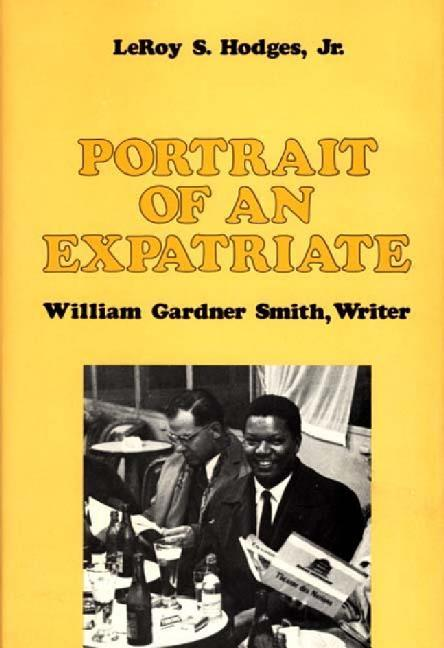
The Stone Face, a novel about an expatriate, brought me to Portrait of an Expatriate, LeRoy S. Hodges’s biography of William Gardner Smith. 

Portrait chronicles the life and works of a Black writer who went to Paris in 1951 to escape racism at home. There he joined other Black émigrés like Richard Wright, James Baldwin, Chester Himes, et al. It is a cradle-to-the-grave story, starting with Smith’s birth and upbringing in the Black ghetto of South Philadelphia (my old neighborhood). Hodges then relates how Smith became interested in literature and writing as a youth: reading Hemingway and becoming editor of his high school newspaper. Next, Hodges details Smith’s time as a young reporter with the Pittsburgh Courier—one of the most important Black newspapers of the day—and his time at Temple University. Smith would eventually leave Temple to focus on his fiction. The author then documents Smith’s time in the army and the publication of his first book, Last of the Conquerors, a story about a Black soldier serving in the racially segregated United States Army in US-occupied Germany after World War II.

In the chapter “On the Way to Paris,” Hodges recounts Smith’s journey to and arrival in France. Initially, he intended to go to Paris for a year—a year that lasted the rest of his days. “This is the second Christmas I spend in a strange European city,” he wrote his mother in 1953, “and, funny to say, I don’t feel like a stranger at all. I feel at home in Paris” (pg. 36).

In “Maturing in Europe,” the author outlines Smith’s time on the Left Bank: struggling to survive, borrowing money, divorcing his first wife Mary, writing in cafés, publishing two novels, working as a journalist, marrying his second wife Solange, expecting his first child.

The subsequent chapter, “From Paris to Africa,” details Smith’s move to Ghana at the behest of Shirley Graham Du Bois—widow of W. E. B. Du Bois. Smith went there to work with Kwame Nkrumah, the fledgling nation’s dynamic president. Smith was happy in Africa, writing for Ghanian TV and teaching journalism. However, after only eighteen months, there was a coup. Nkrumah was forced into exile. Smith was forced to leave. He returned to Paris and resumed his post as an editor at Agence France-Presse (AFP).

“Return to Paris and America” documents Smith’s “homecoming” after a sixteen-year absence. On this trip to the U.S., he reunited with family and friends in Philadelphia and traveled the country to report on racial uprisings and rebellions, visiting several cities, including Cleveland, New York, Detroit, Chicago, Washington D.C., San Francisco, and Los Angeles.

The closing chapter, “Do Not Go Gentle into that Good Night,” relates Smith’s return to France and his last days before succumbing to cancer in 1974. In a sorrowful scene, Smith’s wife asked his friend and doctor Jacques Tomasini if her husband suffered in the end. “No,” Tomasini replied. “It was as if he went to sleep” (p. 101).

***

To pen the book, Hodges thoroughly mined Smith’s published works, unpublished manuscripts, correspondence, and interviews with family, friends, and acquaintances. It is a well-paced biography, only faltering when summarizing Smith’s books (including four novels: Last of the Conquerors, Anger at Innocence, South Street, and The Stone Face; and one nonfiction work: Return to Black America.)

The most intriguing segment of the text covers Smith’s year and a half stay in Ghana, where he met and worked with several famous expatriates, including Shirley Graham Du Bois, Maya Angelou, Julian Mayfield, et al. It was also where he met and interacted with Malcolm X, whom Smith described as “a revolutionary” and “a great man to us” (p. 78).

This is a meticulously researched, beautifully written biography about an author whose books are narrowly read (almost all of them are out of print) and whose name is seldom mentioned. William Gardner Smith deserves greater attention and a wider readership, as Portrait of an Expatriate illustrates.

Still…In 2 It

Still…In 2 It
M. Abduh

In my forthcoming collection, All the Stars Aflame, I have something of an ode to graffiti: a poem entitled “Burner.” It opens, “If crumbling concrete was your only canvas…” The story of ghetto youth. Those who made something from nothing. Graffiti gave us an outlet, a way to express ourselves. & for me, at that time, writing on walls was more important than writing in school notebooks. It was the closest community of writers I’ve ever known. Old heads mentored us & would scrutinize our work closer than any Comp teacher. I can hear my uncle now, “What’s up with them skinny E’s? & why would you put a shadow on both sides of the letter?”

Last weekend, I saw the unthinkable: whole car pieces on a New York City subway train. This made me go back to look at photos of old pieces & reread the biography of a style master, Brooklyn native Dondi White. As a graffiti writer, his work was flawless. His skills were unrivaled. Most writers did top-to-bottom pieces standing on a subway platform, so they could get the letters straight and proportioned. But, as one of Dondi’s fellow writers said, “This man did it two feet away from the train. That is remarkable. You cannot top that. I don’t care if you’re Picasso. I don’t care who you are. You cannot top that. When you can’t see what you’re doing until [the train] is running.”

What’s more, he did this under the cover of night with transit cops all over.

Stories drew me to graffiti. It was the same with Dondi. He told stories with Pilot markers & Rusto spray cans on everything that stood or rolled around New York City, & as his brother Michael White said of him, “He was an extraordinary storyteller.”

By the early 80’s, he moved from trains to canvases, from tunnels to galleries & was one of the first writers to have a one man show in Europe.

Dondi died from complications of AIDS in 1998. & though his work is long gone from MTA lines, many sketches, collages, & photos of his paintings remain.

“Burner” is for Dondi & every graff writer who went down into a subway tunnel, racked spray cans from a hardware store, & tagged walls, lampposts, & mailboxes. It’s for those still…in 2 it.

Forthcoming Collection All the Stars Aflame Available for Pre-order

Please visit https://gfbpublishing.org/shop/ols/products/pre-order-all-the-stars-aflame-by-malik-abduh to preorder this forthcoming collection from Get Fresh Books.

In his debut collection, All the Stars Aflame, Malik Abduh relates the brutal legacy of U.S. racial violence, including lynchings, riots, uprisings, & political assassinations, told in the voices of those who experienced these tragedies firsthand. Likewise, Abduh chronicles his own life experiences: sneaking as a young boy to listen to Richard Pryor records, lamenting the gentrification of his old neighborhood, & struggling to build his daughter a doll house. Thus, this volume is a balance between historical record & personal narrative. Rich with vivid imagery, tragic irony, & dark humor, All the Stars Aflame is a timely poetic debut.

Don’t Be Like Cy

Don’t Be Like Cy
By M. Abduh

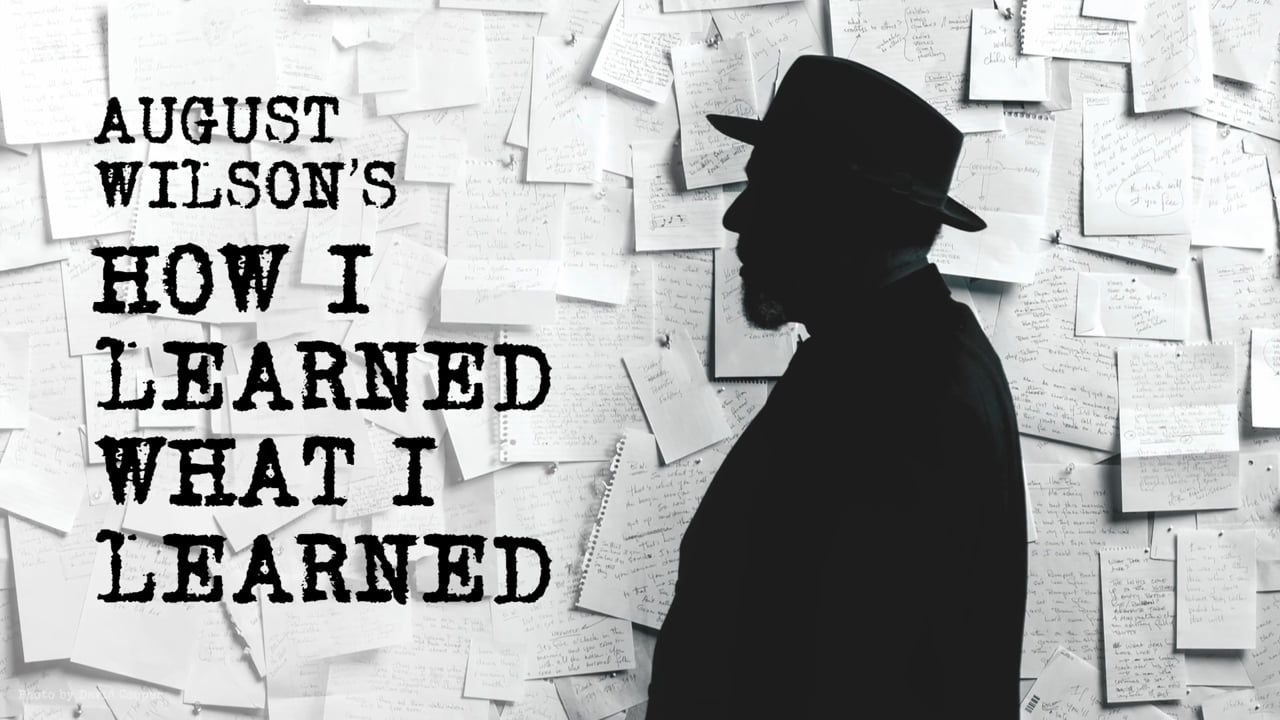
Over winter break, I decided to read all the plays in August Wilson’s Century Cycle. But between finishing Ma Rainey’s Black Bottom and starting Joe Turner’s Come and Gone, I came across the playwright’s one man show, How I Learned What I Learned. (As a longtime admirer of his work, I was embarrassed to know nothing of the play.) It was co-conceived by Wilson’s longtime assistant Todd Kreidler, who said that it is the closest thing to a memoir the playwright left— something of an origin story.

The play, which Wilson originally performed on stage before he took ill, transports us from Spear, North Carolina in the 1930’s to Pittsburgh’s Hill District in the 1960’s. Always the master dramatist and storyteller, Wilson connects several incidents (and accidents) from his childhood and young adulthood to relate the experiences of an unforgettable life. He falls in love. He witnesses a man killed. He is jailed for taking a lawyer’s advice. He stares down the barrels of a shotgun while on a date with a woman named Snookie. The play has irony, humor, and plenty of wisdom. One of the great wisdoms of the play is “don’t be like Cy.” One night, Cy Morocco, a wannabe musician, invited Wilson to hear him play at the Aurora club: “Hey, August man, you going to come down and hear me play?” Wilson agreed, but was surprised to find out that Cy played the sax. He was even more surprised when he arrived at the club and heard Cy playing—or, as Wilson puts it, heard him “making a lot of noise.” It turned out Cy didn’t play the sax after all. From this, Wilson learned an important life lesson: “August,” he said to himself, “you want to be a writer, right? Learn how to do it. Don’t be like Cy.”

Unfortunately, I was unable to unearth a recording of Wilson’s performance. I would love to have seen him on the stage with nothing but a desk, a stool, a coat rack, a copy of Webster’s Third New International Dictionary—and his words. And while this play is not as well-known as Fences or Seven Guitars or The Piano Lesson, it is equally important. It is a glimpse into the people and places that inspired his characters, dialogue, settings. It is the portrait of an artist as a young man and the crucible in which his body of work was forged.

Marvelous One

Marvelous One
By M. Abduh

“If they cut my bald head open, they will find one big boxing glove.” —Marvelous Marvin Hagler

To be honest, I rooted for Sugar Ray Leonard. After Muhammad Ali, Sugar Ray was my favorite fighter. He had all the gifts: fast hands, quick feet, enormous heart. But I also had love & the upmost respect for Marvelous Marvin Hagler, like all boxing people I knew. But before his fight with Leonard—& certainly after it—Hagler felt anything but loved or respected: “What do I have to do to get the recognition?” he said in an interview. “Do I have to kill someone?” (He even legally changed his name to Marvelous Marvin Hagler, so announcers would be forced to call him “Marvelous.”) Nevertheless, throughout his career, he earned his respect. A three-round war with Tommy Hearns & an epic battle with John “The Beast” Mugabi are but two examples of why Marvelous Marvin Hagler is universally revered.

Born in Newark, New Jersey, Hagler’s family moved to Brockton, Massachusetts in 1967, after the Newark rebellion. At the time, Brockton was known for another fighter. It was the birthplace of former heavyweight champion Rocky Marciano. Hagler started boxing around 1969 in a gym owned by the Petronelli brothers, Pat & Goody, who became his handlers. Hagler turned pro in 1973. After going unbeaten in his first three years, (including a draw on November 26, 1974, with the other Sugar Ray—Sugar Ray Seales), his first loss came at the hands of Bobby “Boogaloo” Watts on January 13, 1976. Then he lost to Willie “The Worm” Monroe on March 9, 1976, both at the Spectrum in Philadelphia. He would go on to avenge both losses & would not lose again until April 6, 1987. A loss he would not avenge.

A southpaw who could also fight orthodox, Hagler’s style was relentless. He walked down opponents & worked nonstop. He always entered the ring in top form, a result of his rigorous training regimen. Former heavyweight champion Lennox Lewis said that Hagler “was the one I emulated my own training camps after, when I saw how seriously he took training camps.” Hagler was so feared, he did not get a title shot until 1979 against middleweight champ Vito Antuofermo—after fifty-three fights. Former heavyweight champion Smokin’ Joe Frazier explained why Hagler had such a hard time getting a title shot: “You’re black, you’re southpaw, & you’re good,” he said. And although he got his shot that night in Las Vegas, he did not get his belt. The bout ended in a controversial draw, with Antuofermo retaining the title. Hagler would later say that this fight taught him not to leave things in the hands of judges. He would instead “destruct & destroy” with his own hands.

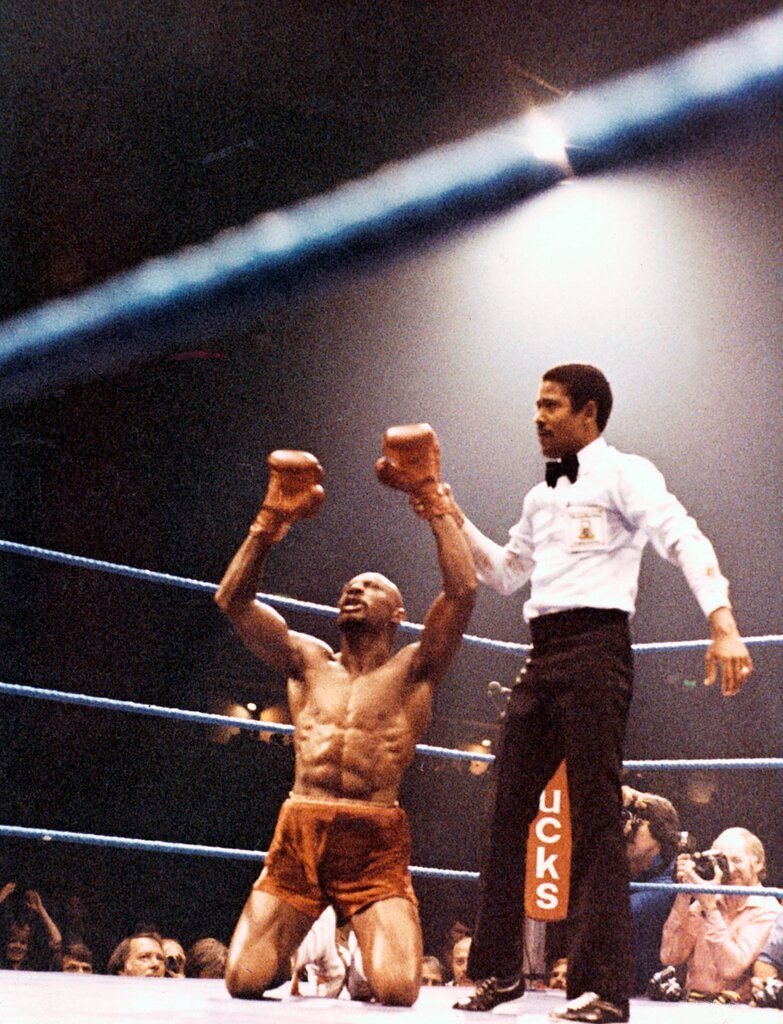
Hagler finally became world champion on September 27, 1980 after defeating Alan Minter in Wembley Arena. With a third round TKO, he won the WBA, WBC, & Ring middleweight titles. Before the fight, Minter was quoted as saying that he did “not intend to lose his title to a Black man.” The audience that night had similar intentions. After Hagler dispatched Minter in three rounds, the crowd hurled beer bottles into the ring. Hagler had to be surrounded by cornermen, then by bobbies, & rushed to safety. & while he did not get to hold up his new belts in the ring, he was the undisputed middleweight champion of the world, a title he would successfully defend for the next seven years, completely dominating the division—until he faced Sugar Ray Leonard.

It was touted as a dream fight. “War II,” Hagler called it. After visiting both camps, HBO sportscaster Barry Tompkins said that “if looks win fights, then this fight is dead even. Both of them look ready, right now.” Before the fight, Leonard said that the first round was important. He needed to get off to a fast start & get Hagler‘s respect. Hagler, to the surprise of many, started the fight in the orthodox stance (even though Leonard had been struggling with southpaws throughout training camp), while Leonard tiptoed around every inch of the 20-foot ring. Leonard took the first round. Moving well & clinching often, he took second round as well. Those first two rounds would prove pivotal to the judge’s decision. Leonard went on to win the early rounds. Hagler took the middle rounds. Hagler was more aggressive, but Leonard was able to stay on his bicycle & throw enough flurries to outscore Hagler. After a close fight, announcer Chuck Hull read the decision: “The winner by split decision &…new middleweight champion of the world: Sugar Ray Leonard! (The judges scored the fight 118-110, 115-113, & 113-115.) A visibly stunned & incredulous Hagler continued to shake his head and repeat that he won the fight, that he had been robbed by the judges. He was not alone in his opinion. Over the years, many fight fans & boxing experts have expressed their belief that Hagler indeed won the fight. But as I said that night to my father, & have repeated ever since, the fight was so close I could see it going either way. But “robbed” Hagler was not.

Unfortunately, this would be Hagler‘s final fight. After Leonard denied him a rematch & a chance to even the score, Hagler retired. He left the States for Italy & remained there for many years, becoming something of an action film star. He was inducted into the International Boxing Hall of Fame in 1993, finishing his career at 62-3-2, 52 KO’s. Like his fighting style, Hagler’s road to the middleweight crown was hardscrabble, but he reigned atop the division for years, successfully defending his title twelve times. Ring magazine, the “Bible of Boxing,” named him the fourth greatest middleweight in history.

After news of his death on Sunday, tributes poured in from the boxing world. Former heavyweight champion Mike Tyson tweeted: Marvin Hagler was one of the best warriors in the sport. Condolences to his family.  He will be missed. Promoter Bob Arum said of him, “He was a man of honor & a man of his word, & he performed in the ring with unparalleled determination. He was a true athlete & a true man.” As for his old nemesis, Sugar Ray Leonard tweeted, You are definitely gone too soon. But you will forever live on as one of the greats. Marvin Hagler was indeed one of the greatest, the epitome of skill, pride, grit, determination, & heart. In a word, he was Marvelous.

The Everyday Muses of August Wilson

By M. Abduh

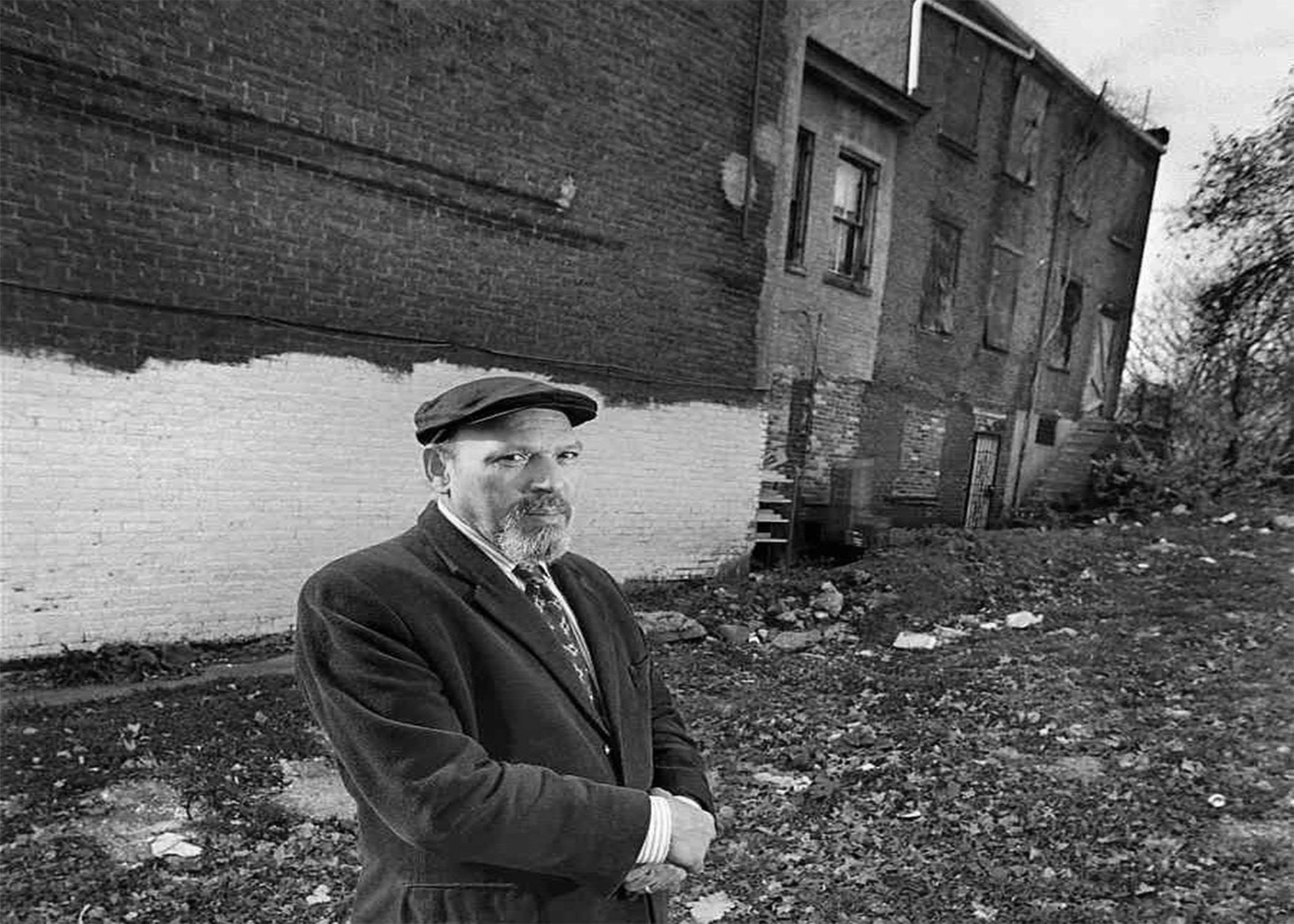
The distinction of August Wilson’s work lies not in the epic, but in the everyday. As one producer put it, “[Wilson] was not drawn to writing about big, historical events. I don’t think he was ever gonna put Frederick Douglass on the stage.” Instead, he peopled his plays with garbagemen, trumpet players, and cab drivers. As Wilson deeply understood and appreciated the will and resolve of these uncelebrated men and women who somehow survived the terror of the cudgel, the noose, and the shotgun; who somehow migrated north, made homes, and raised families in the teeth of contract lenders and redliners. He felt no need to put Douglas on the stage because “I happen to think,” he said in an introductory note to Seven Guitars, “that the content of my mother’s life—her myths, her superstitions, her prayers, the contents of her pantry, the smell of her kitchen, the song that escaped from her sometimes parched lips, her thoughtful repose and pregnant laughter—are all worthy of art.” He elucidates this beautifully in his Honorary Doctorate acceptance speech at Howard University:

I am standing here in my grandfather’s shoes. They are large shoes. They are the shoes of a whole generation of men who left a life of unspeakable horror in the South and came north, searching for jobs and a way to live life with dignity and whatever eloquence the heart can call upon. They came from the cotton fields of Georgia and Arkansas and Mississippi, from the chain gangs of Alabama, from the cane fields of Louisiana, and in my grandfather’s case, from the tobacco fields of North Carolina. They came carrying Bibles and guitars. Marked men seeking a way of bludgeoning and shaping the malleable parts of themselves into a new identity as free men of definite and sincere worth. They brought with them manners and a way of life that corresponded to their temperament and sensibilities. And it is this field of manners and rituals of social intercourse, out of which I make my art.

So, while Shakespeare wrote of kings, Wilson wrote of kinfolk:

Bynum Cutler.
Savage, mule trainer, singer,
shaper of wood and iron.

Bynum Cutler,
who spread his seed
over the nine counties
in North Carolina,
seed carried in the wind,
by the wind in the sails of ships
and planted among the cane break,
among Georgia pine,
among boles of cotton
planted in the fertile fields of women
who snapped open like fresh berries,
like cities in full season
welcoming its architects
and ennobling them
with gifts of blood.

“This is a poem I wrote for my grandfather,” he said of these lines. “Since I never knew my grandfather, I am speaking in a generational sense, a generational grandfather. This is your grandfather, my grandfather, all of us’s grandfather.” Thus, his plays and poetry sprung from his mother’s kitchen, from his grandfather’s shoes—as noble as anything written for or about any king.

“But why don’t you start with your grandmother and work your way back to Timbuktu, so you can understand who you are?

Wilson wanted audiences to know that these were not small lives. Through them, we are wedded to the glorious past. When his daughter went off to Morgan State University, she joined a student organization. “We’re studying about Timbuktu,” she called and told him. “That’s good,” he replied. “But why don’t you start with your grandmother and work your way back to Timbuktu, so you can understand who you are? And if you want to get your connection with Timbuktu, you got to go through your grandmother—and you’ll get to Timbuktu and the great empires of Africa…but you’ll also know better who you are having made that journey.” Thus, we not only come from a handful of kings and queens, but from millions of folk who crossed oceans, rebelled against enslavers, sang the blues, fried okra, pitched horseshoes, and spoke the poetry of the Mississippi Delta, the Hill District in Pittsburgh, and the Southside of Chicago. The poetry Wilson put in the mouths of everyday people like Levee, Rose Maxson, Berniece, and King Hedley II. All of whom are worthy of art.