Portrait of an Expatriate
Reviewed by M. Abduh
“I left to prevent myself from killing a man.” –Simeon Brown, The Stone Face
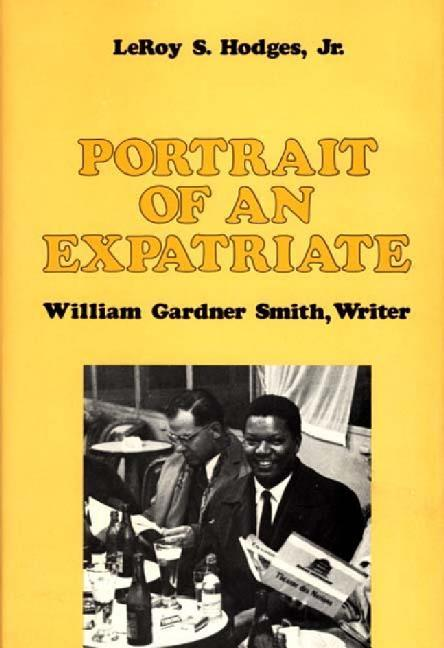
The Stone Face, a novel about an expatriate, brought me to Portrait of an Expatriate, LeRoy S. Hodges’s biography of William Gardner Smith.
Portrait chronicles the life and works of a Black writer who went to Paris in 1951 to escape racism at home. There he joined other Black émigrés like Richard Wright, James Baldwin, Chester Himes, et al. It is a cradle-to-the-grave story, starting with Smith’s birth and upbringing in the Black ghetto of South Philadelphia (my old neighborhood). Hodges then relates how Smith became interested in literature and writing as a youth: reading Hemingway and becoming editor of his high school newspaper. Next, Hodges details Smith’s time as a young reporter with the Pittsburgh Courier—one of the most important Black newspapers of the day—and his time at Temple University. Smith would eventually leave Temple to focus on his fiction. The author then documents Smith’s time in the army and the publication of his first book, Last of the Conquerors, a story about a Black soldier serving in the racially segregated United States Army in US-occupied Germany after World War II.
In the chapter “On the Way to Paris,” Hodges recounts Smith’s journey to and arrival in France. Initially, he intended to go to Paris for a year—a year that lasted the rest of his days. “This is the second Christmas I spend in a strange European city,” he wrote his mother in 1953, “and, funny to say, I don’t feel like a stranger at all. I feel at home in Paris” (pg. 36).
In “Maturing in Europe,” the author outlines Smith’s time on the Left Bank: struggling to survive, borrowing money, divorcing his first wife Mary, writing in cafés, publishing two novels, working as a journalist, marrying his second wife Solange, expecting his first child.
The subsequent chapter, “From Paris to Africa,” details Smith’s move to Ghana at the behest of Shirley Graham Du Bois—widow of W. E. B. Du Bois. Smith went there to work with Kwame Nkrumah, the fledgling nation’s dynamic president. Smith was happy in Africa, writing for Ghanian TV and teaching journalism. However, after only eighteen months, there was a coup. Nkrumah was forced into exile. Smith was forced to leave. He returned to Paris and resumed his post as an editor at Agence France-Presse (AFP).
“Return to Paris and America” documents Smith’s “homecoming” after a sixteen-year absence. On this trip to the U.S., he reunited with family and friends in Philadelphia and traveled the country to report on racial uprisings and rebellions, visiting several cities, including Cleveland, New York, Detroit, Chicago, Washington D.C., San Francisco, and Los Angeles.
The closing chapter, “Do Not Go Gentle into that Good Night,” relates Smith’s return to France and his last days before succumbing to cancer in 1974. In a sorrowful scene, Smith’s wife asked his friend and doctor Jacques Tomasini if her husband suffered in the end. “No,” Tomasini replied. “It was as if he went to sleep” (p. 101).
***
To pen the book, Hodges thoroughly mined Smith’s published works, unpublished manuscripts, correspondence, and interviews with family, friends, and acquaintances. It is a well-paced biography, only faltering when summarizing Smith’s books (including four novels: Last of the Conquerors, Anger at Innocence, South Street, and The Stone Face; and one nonfiction work: Return to Black America.)
The most intriguing segment of the text covers Smith’s year and a half stay in Ghana, where he met and worked with several famous expatriates, including Shirley Graham Du Bois, Maya Angelou, Julian Mayfield, et al. It was also where he met and interacted with Malcolm X, whom Smith described as “a revolutionary” and “a great man to us” (p. 78).
This is a meticulously researched, beautifully written biography about an author whose books are narrowly read (almost all of them are out of print) and whose name is seldom mentioned. William Gardner Smith deserves greater attention and a wider readership, as Portrait of an Expatriate illustrates.

 The Echo Tree