The Dream Deferred
By M. Abduh
14 January 2019
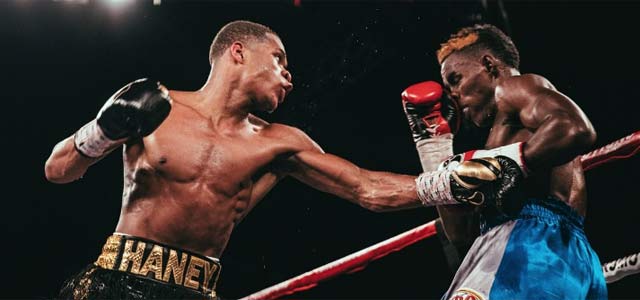
There is a significant difference between a prospect and a contender. While the prospect possesses all the skills: speed, accuracy, defense, punching power, etc., what is missing is a strong test of those skills. The prospect has yet to face the kind of competition that allows him to cross over. Lightweight Devin “The Dream” Haney is well-aware of this difference. For months now, he has rejected being called a prospect and has demanded that he be considered a contender. He certainly possesses all the tools. Floyd Mayweather Sr, one of Haney’s trainers, said that he has not seen a young fighter with the natural instincts, timing, hand and eye coordination, etc., since his son, Floyd Mayweather Jr., arguably the best pound for pound fighter of his era. Yet many sportswriters and commentators have continued to label Haney a prospect, and he has taken exception to this, as if someone had called him out of his name. “[A] prospect,” Haney explained, “is somebody that’s coming up, that’s trying to get to the top or coming up or trying to make a name for themself. I feel like I’m already there. I’m ranked in the top ten of three sanctioning bodies, so I’m already up there with those top guys.” This is not mere braggadocio from a brash young fighter; Haney is mature beyond his years in the ring. He has fought smart and done all the right things in his career so far. He has met everyone who has been presented to him, facing a good puncher in Menard, a veteran in Burgos, and a skilled boxer in Ndongeni. And how can anyone say that he is speaking out of turn, especially in a time when a fighter with only thirteen professional fights can be considered the pound for pound best fighter in boxing? (Sadly, I recently saw an interview where a “fight expert” claimed this same fighter–with only thirteen matches–is the best pound for pound fighter ever. It makes Haney’s insistence that he be called a contender seem more than justified.) Haney helped solidify his argument Friday night with a superb performance against the former South African lightweight champion, Xolisani Ndongeni (25-1, 13 KO’s), a former rugby player, who also entered the ring unbeaten.
Their fight was preceded by two good undercard bouts. The first, a heavyweight contest between former pro football player Willie “the Snake” Jake Jr. (8-2-1, 2 KO’s) and Frank “Freedom Fighter” Sanchez (11-0, 9 KO’s) of Cuba. Their eight-round contest was interrupted when one of the middle ropes came loose. It took almost fifteen minutes to fix the problem. But it would only take Sanchez a couple of minutes in the second-round to fix Jake Jr., catching him with a combination of punches and sending him face-first to the canvas.
The second undercard fight featured unbeaten featherweight prospect Ruben Villa (15-0, 5 KO’s), who completely outclassed his opponent Ruben Cervera (10-1, 9 KO’s) of Colombia, winning every round on each of the judges’ scorecards.
Then came the main event. The first two minutes of round one consisted of the fighters “feeling each other out”: bouncing, jabbing, missing, clinching. Then, after the clacks signaling the last ten seconds of the round, Haney threw a series of sharp punches, including a straight right hand, that caught Ndongeni good.
In the second round, Haney began to shoot a hard jab that snapped Ndongeni’s head back. Then, with 1:33 remaining in the round, Haney put Ndongeni on his backside with a chopping right hand. In fairness, the young South African was not badly hurt by the shot; he simply got caught off balance trying to move away from action. Either way, the knockdown gave Haney a 10-8 round.
Throughout the third and fourth rounds, Haney threw some good combinations and was the busier fighter, though he spent most of this time headhunting. Between the fourth and fifth rounds, Haney’s second assistant, his father William Haney, implored him to target his opponent’s body. In the fifth, he seemed to take heed, firing shots to Ndongeni’s midsection and causing him to backpedal to the ropes. Haney continued to rip body shots in the sixth and seventh rounds but never forsook his jab. In the seventh, one of these jabs sent Ndongeni’s mouthpiece across the ring. There were several moments in the fight where Haney seemed on the verge of putting his opponent away, but the South African was, as announcer Barry Tomkins stated, “a game opponent.” He had not come to lie down.
In the tenth and final round, Haney walked Ndongeni down throwing reaching right hands. He seemed desperate to score a knockout. But as the final bell sounded, both men remained upright. By my count, Haney won every round, including a 10-8 round in the second. Two of the three judges concurred, scoring the fight 100-89 for Haney. The third judge, along with announcer Steve Farhood, gave Ndongeni one round, scoring the fight 99-90. (Perhaps a case can be made for giving Ndongeni the seventh round, in which he occasionally scored with a looping overhand right, despite losing his mouthpiece.) So, instead of a knockout, Haney would have to settle for a unanimous decision. And though he dominated the bout from the opening bell, his technique in the fight was not flawless. Haney’s trainers will need to work on the young fighter’s defense. He is prone to drop his left hand to his hip bone, leaving his jawbone wide open. And if boxing is truly all about “hitting and not getting hit,” Haney needs to work more on avoiding his opponents’ counterpunches. But after outclassing a quality opponent in Ndongeni, he deserves, finally, to be upgraded from prospect to contender, and he could not have been more emphatic about this after his victory. In the post-fight interview, he said, “I’m sure the people know what I’m going to say next. I’m a fucking contender!” He then stated that he wants to face the best competition that 135 has to offer. “I don’t turn down anybody, no matter what record. Like I said before, I’m willing to fight those top guys.” At the end of the interview, Steve Farhood asked what’s next for him, after three impressive wins. “Now they can’t deny me,” he replied. But if they continue to do so, it raises the question, what happens to “The Dream” deferred?
 The Echo Tree