Guarding Moonlight
M. Abduh
November 15, 2018
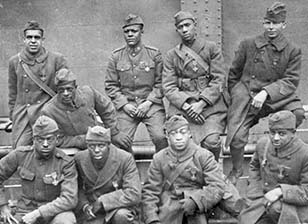
MOST AMERICANS HAVE NEVER HEARD OF ROY UNDERWOOD PLUMMER, black soldier, doctor, Francophile. He is also the author of a diary chronicling his day-to-day experiences during the Great War. His niece, Gretchen Roberts-Shorter, who died in 2017, inadvertently found the 3 ½” by 5 ½” leather bound journal, which she initially mistook for a small telephone book, while cleaning out her uncle’s attic after the home had been sold. What she discovered astonished her: a neat hand detailing shopping trips, guard duty, military operations, and a race riot. “When I first started reading,” Roberts-Shorter said, “I noticed how well he wrote, and I thought how beautifully he must have spoken.” The great playwright August Wilson stated that “the simpler you say it, the more eloquent it is.” And Plummer’s prose style is indeed simple and eloquent:
Sunday, November 3, 1918
The dawn brushed back a curtain that concealed in its folds a place that really seemed deserving of the term “God-forsaken.” A mere handful of barracks, scarcely more than eight or ten, several thousand feet of lumber, a miniature saw mill, almost a thousand German prisoners and probably less American troops being the only plausible excuse for attaching camp to Talmont.
Plummer was a clerk during the war, most likely because of his writing skills. This was considered a “soft” position, whereas black troops were normally forced to perform menial tasks: heavy labor, setting up camps. What soldiers called “grunt work.” But even when describing mundane activities, like guard duty, his writing could be imagistic. On January 26, 1918, he writes, “Called for the first time for guard duty. Bright moonlight.” One can also see his eye for detail when he writes about a shopping excursion. On May 18, 1918, he wrote, “Went to the town of Libourne in a truck. Saw there a meat market, where nothing but horse meat was sold.”
Detailing one military operation, on Tuesday, January 15, 1918, he wrote, “Ocean very rough. Marines claim there is less submarine operation in such waters, as its periscopes have to be projected much further out of the water and can be more easily seen.” Some operations, however, were not against foreign forces, but against men wearing the same uniform.
Thursday, December 19, 1918
Frictions between the races. Though the colored troops are not equipped with guns, according to all reports, they behaved themselves most bravely and pluckily against the Marines. It seems that the trouble started in a café when a sergeant made some remark which displeased the colored “boys” there and resulted in the sergeant receiving a severe trouncing. The sergeant then really informed his men and incited a riot.✱
Overall, black soldiers were treated well by French citizens, better than they were treated in Uncle Sam’s army, better than they were treated at home. Plummer felt welcomed in France and immersed himself in the French language, until becoming fluent: On Tuesday, February 12, 1918, he writes, “Went to Bordeaux, purchased some books. Teaching French. Told by cultured woman that I have made wonderful progress in learning French (Bs’ing me? Ha ha).”
A diary from a black WWI soldier was a rare find. Margaret Vining of the Smithsonian said, “From World War I, we have some really fine uniforms and photographs and other materials, but not a diary [from a black soldier].” Roberts-Shorter wanted two things for the diary. She wanted it “to be safe and preserved for posterity in an institution that is hopefully timeless.” This wish was realized when she donated it to the National Museum of African American History and Culture. She also wanted to see it published. Unfortunately, she did not. One can only hope that day soon comes, so the world, like Roberts-Shorter, can discover the stories, struggles, and sacrifices of soldiers like Roy Underwood Plummer.
✱ He goes on to mention “a loss of life” that occurred during the riot.
 The Echo Tree