From Autobiography to Diary: The True Legacy of Malcolm X
By M. Abduh
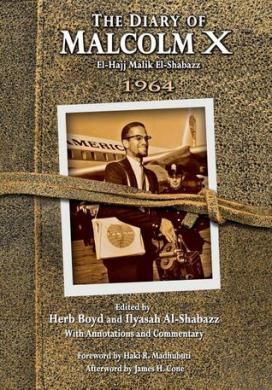
I WAS AROUND FIFTEEN when an older cousin gave me the Autobiography of Malcolm X while helping him clean out his basement. I have little recollection now what drew me to the book. I didn’t know much more than his name up to that point. Perhaps it was the cover, an image of Malcolm, piercing eyes behind those horn-rimmed glasses. He looked like he could “drop science.” He looked serious. I asked my cousin if I could have the book. When he handed it back to me, without even looking up from the stack of paperbacks in front of him, he said: “You not gon’ like it. He was racist.” Needless to say, big cuz was wrong on both accounts.
At the time, I was in some trouble—academically, and legally. Along with failing almost every one of my classes, I caught a vandalism charge for tagging up our school. This got me suspended, and earned me close to fifty hours of community service painting over my “defacement of public property.” I couldn’t have been introduced to The Autobiography at a better time. I found a purpose, direction in its pages. It was all I wanted to talk about. Once, sitting in the pizza shop with two of my closest friends, Madi and Jay, I gave what I thought was a university dissertation on Malcolm’s pilgrimage to Mecca. Jay, with his head tilted catching a string of cheese from his slice, said: “Sound like you about be selling oils and incense soon.” We laughed. And I thought he was probably right. To be honest, we were not very enlightened about the faith at the time; we only knew you prayed five times a day, made pilgrimage to Mecca, and avoided anything with lard in it. Of course, I also didn’t know anything about the questions surrounding Alex Haley’s work on the book (or Haley for that matter), or the number of flawed biographies that followed. But what remains without question is that the truth of Malcolm’s life—and ultimate sacrifice—transcends and outstrips these flawed, and, at times, spurious works; the truth he penned in his own hand, traveling across three continents.
“Whoever is not thankful to the people is ungrateful to God,” says an old tradition. And I am ever thankful to all who played a part in the publication of The Diary of Malcolm X, above all, its author. How impatiently I waited for the book—sitting in manuscript form in the Schomburg Center for over a decade—to be published, waited in disappointment by the delays and courtroom battles holding up its release. When Third World Press was finally able to distribute the book, I ordered it and read it with its packaging still on my lap; and I say without exaggeration, it gave me the greatest sense of relief since finishing Manning Marable’s Malcolm X: A Life of Reinvention. I do not desire, by any stretch, to disparage Dr. Marable, for I recognize and honor his great contribution to the scholarship of black studies. But no matter how loved the person, the truth must always be more beloved. And as a son of Malcolm, it was clear to me that Dr. Marable’s book, in many ways, distorted not only my ancestral father’s story, but mine own as well. For my narrative is not so different from the countless black youth (and many more elders) in America—nay, across the globe—who have been profoundly and forever changed, and in fact shaped, by the life and legacy of brother Malcolm.
Malcolm X: A Life of Reinvention was hailed in many academic circles as the definitive work on the life of the OAAU founder, Marable’s magnum opus. I was hopeful. But when word of the some of the book’s “disclosures” began to spread, the hope spoiled, turning to worry. I plowed through the book—no small task for a tome of its density. Upon reading the final words of the epilogue and closing the text, I leaned back in my seat and felt trouble in my soul, trouble in my way.
Talcum powder?
Adulterer?
A cuckold?
And these more salacious passages of the book were not even the most egregious of its errors. Thankfully, a number of writers and scholars have since clarified that these reports do not meet the standards of scholarly research: accounts whose sources are persons unknown or unnamed, government and law enforcement agencies: FBI, CIA, BOSS, etc., as well as some of Malcolm’s well-known haters. Thus their credibility, without doubt, is in question, or in the words of Public Enemy, “Can’t truss it.” Moreover, these reports weren’t even a revelation. They were tales that had circulated in the 1990’s, blackening the pages of books that claimed to fill in the lines of Malcolm’s story, to humanize him. What is even more erroneous in A Life of Reinvention (or, more correctly, A Lie of Reinvention) is the distortion of Malcolm’s post-Hajj mission: the continued struggle to bring down the house of “dollarism” raised on the back of black and brown exploitation. And while it is true that Malcolm’s extensive travels the year before his assassination brought new insights, a more global outlook on the problems facing America’s twenty million blacks, it is equally true that until his last breath on the stage of the Audubon Ballroom, he remained a revolutionary, Pan-Africanist, and staunch opponent of America’s system of white supremacy. If one needs proof of this, he need look no further than the film reels, the speeches, and the diary he kept on those travels. “I have not bitten my tongue once,” he writes in one entry, “nor passed a single opportunity in my travels to tell the truth about the real plight of our people in America.” There are numerous passages in the diary similar to this. Passages that demonstrate his undying effort to shine a light on the oppression and degradation blacks have endured for generations; centuries of slavery, Jim Crow, lynching, rape, incarceration, exile, and death.
***
WHILE IT IS TRUE that the biographer must seek to humanize his subject, he should not look to do so through rumor, gossip, and speculation. The biographer, after all, is not a scandalmonger. For some, though, it seems, to humanize a Malcolm (or a Martin) is to simply find a way to pull him down from on high, show the masses that up close the angel’s wings more resemble a buzzard’s. However, Malcolm’s own words, for the sincere chronicler, contain enough truth to humanize him, without need of fictions. He would often trace his own missteps and shortcomings in interviews, speeches—and in The Autobiography. He was flawed, and ultra-aware of it. This attribute is part of what makes him such a singular hero. I can remember my first reading of his autobiography. A reading that leveled everything on my landscape. Yet, at the same time, I recall how uneasy Malcolm’s blind attachment to Elijah Muhammad made me. How every other sentence in those middle chapters began or ended with “The Honorable Elijah Muhammad says such…The Honorable Elijah Muhammad says thus.” And while I was aware of his ardent desire to honor his teacher, to honor the man he said found him in the “muck and mire,” the echo of the phrase was deafening. But by the final chapters, Malcolm would recognize and acknowledge this flaw:
In Mecca, too, I had played back for myself the twelve years I had spent with Elijah Muhammad as if it were a motion picture. I guess it would be impossible for anyone ever to realize fully how complete was my belief in Elijah Muhammad. I believed in him not only as a leader in the ordinary human sense, but also I believed in him as a divine leader. I believed he had no human weaknesses or faults, and that, therefore, he could make no mistakes and that he could do no wrong. There on the Holy World hilltop, I realized how very dangerous it is for people to hold any human being in such esteem, especially to consider anyone some sort of “divinely guided” or “protected” person.
He states elsewhere:
I did many things as a [Black] Muslim that I’m sorry for now. I was a zombie then—like all [Black] Muslims—I was hypnotized, pointed in a certain direction and told to march. Well, I guess a man’s entitled to make a fool of himself if he’s ready to pay the cost. It cost me twelve years.
In an interview for the documentary Eyes on the Prize, actor Ossie Davis was asked about interactions between Malcolm and some of the civil rights leaders of the time. Davis related an exchange that took place between Malcolm and playwright Lorraine Hansberry at a meeting, after his return from Hajj in 1964. Hansberry’s husband was white, and Malcolm had previously excoriated those who married outside of their race. Davis recalls that Hansberry “took [Malcolm] to task” about some of these earlier statements. When she finished, Malcolm simply looked at her and apologized: “I said that because that’s what I thought at the time. But I’m sorry that I said that because now I see that that’s wrong and I hope you will understand and forgive me…I’m bold enough to say that I’ve changed my thinking. I’m sorry about that but that’s what I believed at the time.”
Admissions all too human.
And his diary is an even greater testimony to this. At times we find him second-guessing decisions: “I find myself wondering increasingly how things are going in the states & if I’m overplaying my hand (gamble) by staying away too long.” Other times we find him melancholy blue. In his entry on Fri. Oct. 30, he writes: I had dinner alone at the hotel & retired early feeling a bit lonely.” Then, on Mon. Nov. 16, he writes: “I went for a walk in the rain, alone and feeling lonely.” Again, on Tues. Nov. 17, he states: “I walked around Paris & finally had a midnite, lonely dinner across from my hotel.” There are a number of such entries, and after reading them, one cannot help but be overcome with great sympathy for the “indomitable” Malcolm X. And not only does he allow the reader into moments of self-reflection, but self-satisfaction as well. In his Mon. Nov. 16 entry, he writes: “I slept late then went to buy an overcoat. I’m not very good at shopping for anything. By 4 pm I had finally selected a suit and an overcoat. I felt like a new man when I left the store fully togged. Decent clothes are a psycho boost.” These moments reveal more about the man than many of the works that have been written about him. For this reason, journalist and co-editor Herb Boyd stated that the diary “humanizes him in a way that some of these other scholars set out to do. This is Malcolm uninterrupted. Without any kind of editorial interference.”
***
The Diary of Malcolm X, written in the author’s plainspoken style, covers two trips abroad in 1964. The entries begin on April 15th and end on November 17th, detailing his travels across Africa, the Middle East, and Europe. He not only catalogues the heads of state, their representatives, and organizations he encounters, but also describes towns and landscapes like an Imagist: “Mecca is surrounded by mts, the cruelest looking mts. I’ve ever seen. They seem to be made of the waste material from a blast furnace. No vegetation on them at all.” Entry after entry, he takes the reader to Dakar Airport, the Carlton Towers Hotel in London, and King Tut’s Tomb at the Cairo Museum. It is the chronicle of a man in perpetual motion, in search of answers and solutions to centuries old dilemmas, finding those answers in even older bonds and ties; all the while being surveilled, threatened, targeted, and poisoned. It was due to these whirlwinds circling him that more than one head of state offered him refuge in their lands, but he humbly declined. He felt it his duty to return home and continue the struggle alongside the twenty million other black men, women, and children who had no safe-haven. And at the end of November, he indeed returned home; returned to attempted knifings, a fire-bombing, agents infiltrating his ranks, death squads being assembled in cities across the country, and, finally, shotgun blasts on a Sunday afternoon in the Audubon.
Near the end of the epilogue to The Autobiography, Alex Haley writes that Malcolm signed the contract for the book, gave him a hard look and said: “A writer is what I want, not an interpreter.” Well, this is what the reader gets in the diary. The writer is Malcolm, without Haley or anyone else as interpreter.
 The Echo Tree