Laugh Now
By M. Abduh
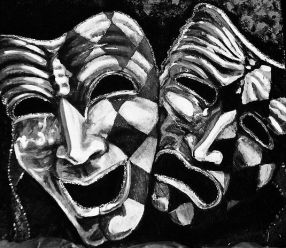
THE SUGAR WATER LOUNGE has hosted an open mic night once a week for close to two years, popular with area wannabe’s: singers, spoken word artists, and comedians who have few other options on Thursday nights. Everyone here has certainly seen these performers touch the mic a hundred times, like some repeated punishment in the afterlife. When I arrive, early in the evening, there are not enough people to actually call it a crowd. It is more of a spattering of patrons at tables, some eating and drinking; many focused on their cell phones, all eyes and thumbs on lit screens. Others sitting at the bar talking or shaking their heads at the game playing overhead, the Sixers again down by double digits. In the back of the room sitting at a table that should have been cleared two rounds ago is aspiring comic AJ Blackwell, who’s been coming to Sugar Water’s for close to a year now to work on his set. Every few seconds, he looks over an index card lying on the table. It’s creased down the middle widthwise and filled with bulleted notes in green ink. There was a time, he says, when he didn’t need to look at anything before a set; once boasting an almost photographic memory, able to read back paragraphs of text by heart after looking over it for only a few minutes. Next to the panoply of shot glasses and plastic cups (he swears only the water bottle is his) is a deck of playing cards. He arranges the cards according to suit and number then begins to flip them over, a memory boosting trick he saw on YouTube. He’s fidgety. Picking at his beard with his fingers like he’s trying to remove rice. His left foot planted next to the table leg, his right tapping rapidly against the floor. A casual observer might mistake this for performance anxiety, but this isn’t stage fright. The comedian’s behavior is the result of a previously diagnosed condition. AJ suffers from bipolar disorder. Those who know him would guess from his behavior that he’s off his meds again. Often, especially before sets, he skips doses, complaining that they drain him, prevent him from sleeping. “I feel like had a lobotomy when I take those fucking drugs.”
Well before his diagnosis, he was always obsessed with comedy. His older brother, who works for a local radio station, recalls his childhood fascination. “He loved all that goofy shit—The Muppets, Bugs Bunny. But he was scared to death of that Tasmanian Devil. He would pee the bed at night instead of going to the bathroom. Thought the Tasmanian Devil would jump out and get him in the hallway.” Simply the result of a child’s overactive imagination, the family reasoned, but as he grew, so too did his fears.
* * *
THE ROOM ALMOST DOUBLES in an hour, right before the open mic is set to begin. Some singers and a few spoken word artists have also signed up. AJ hates to sit through spoken word. To him they sound too much like neo-Beatniks stretching their vowels into the clouds, Wake uuup! Up Waaaake! Wakin’ uuuup! To-what-is-uuup! Poems filled with abstractions: Love, and longing, Hallmark-ed up rhyme schemes, and stories lamenting days of loss and nights lost in lament. “Why they all sound like that?” he says. “All the same. That Sonia Sanchez shit.” “You don’t like Sonia Sanchez?” I ask. He folds the card and scratches his cheek with it. “Of course,” he says, “that’s my auntie.”
The club’s emcee begins to call the performers up to the “stage.” He means this figuratively, of course, because what he’s actually calling them to is nothing more than an elevated platform beside the bar with barely enough room for a stool and a mic stand. AJ is first. Looking up at him, for the first time, I realize just how imposing a figure he is—over six feet tall, with huge hands. Wilt Chamberlain certainly could have met his mother. He pulls the mic and rubs his forehead. The first joke takes an era to set up, but gets a decent laugh in the end:
To show you how much fat women turn me off…I’m lying in bed one night flipping through channels and an Oprah rerun is on—“Next on Oprah: Famous actress molested as a child by her uncle.” So, I think, this has all the ingredients of a good late night jerk off. Star actress and her dirty uncle. Had my hands under the covers just waiting for the KFC commercial to end—now I’m hungry and horny—comes back on, and Oprah says: “How molestation inspired Mo’nique to give her Oscar winning performance in Precious.” And I’m like wait, did she just say Mo’nique? Chunky ass Mo’nique? Her uncle is dirtier than I thought. My hand was out of the covers and back on the remote. Fuck it. Suzanne Somers must have an infomercial on somewhere.
The routine is irreverent, possessing flashes of potential; though much of the material is raw and misses his audience. But the comic says he refuses to be pigeonholed. “I mean, nothing should be off limits,” he tells me. “Comics like Flip Wilson and Richard Pryor appealed to everyone.” Coming from a student of comedy—like AJ—this seems a strange, almost naïve statement. One with even cursory knowledge of these great comedians knows that they were able to tailor routines to suit their audiences. And although AJ seems quite convinced of the universal quality of the material, some of his references are simply too obscure. A joke about his medication incites a heckler at a table in the back. “People get embarrassed in front of their priests or therapists. Me, I’m most embarrassed in front of my pharmacist. I mean, I’m on Risperdal, Aciphex, and Viagra. So he knows I have head problems, stomach problems, and dick problems.” At this, the heckler yells out, “Hell is Risral?” Over time, AJ says he has gotten better at shutting down hecklers. He looks into the crowd, in the direction of the voice, “It’s a drug, motherfucker. And not like that shit you on…Sure wish I could see your ass. Nigga so black, at his house they call birthdays the Dark Ages.” His comeback gets a good laugh, a smattering of claps, even the heckler seems amused. But AJ is now visibly agitated. He pulls the index card out his breast pocket and squints at it. The mic lands on his thigh in a thud. He wipes his face, and mumbles something under his breath as he steps down and walks toward the bathroom. After a moment, the hush in the room rises in a babel of voices. The emcee quickly calls up the next performer.
* * *
AJ GREW UP IN THE SUBURBS OF SOUTH JERSEY, the youngest of three brothers. As a teenager, he was most proud of his extensive collection of comedy albums and videotapes. He collected Pryor, Dangerfield, and Robin Harris recordings the way his father collected Ahmad Jamal (AJ’s namesake) and Max Roach records. He first took the comedy stage when he was only fourteen. After high school, he attended Farleigh Dickinson University, majoring in English. It was in his second year that his condition worsened. His uncle Vaughn says at this point, the depression took over completely, “He got real quiet, barely left his room…always irritable.” He finally dropped out of school, and the family tried to convince him to see someone. “My sister was so worried about him,” his uncle said, “she took a leave from work to take care of him full time.” He was eventually evaluated and diagnosed with bipolar disorder and depression. After some therapy and being put on antipsychotics, he began to show improvement, returning to some semblance of normalcy. He did, however, complain that the medication made him sluggish and weakened his memory. “I’d take PATCO and wouldn’t remember what town I was in until I saw a sign or something.” And like others who suffer from bipolar disorder, he would go on and off the drugs. I ask how the disease has affected his art. His face balls up, “Not at all.” Perhaps he is right, as some researchers, like Gordon Claridge of Oxford University, believe that the creative elements needed to produce humor are quite similar “to those characterizing the cognitive style of people with psychosis—both schizophrenia and bipolar disorder.” Claridge also states that “manic thinking, which is common in people with bipolar disorder, may help people combine ideas to form new, original and humorous connections.” However, one should be careful not to romanticize such connections, as many who suffer from mental illness are far from creative geniuses.
After almost ten minutes in the bathroom, AJ emerges wiping his face with a ball of toilet paper, small pieces of tissue stuck to his forehead. He leans against the wall next to the exit and watches the comedian on stage. The crowd erupts in laughter at one of his jokes, but AJ only grins. Those close to him say that a smile and a light chuckle is about the most you will get out of him, no matter how funny the routine. “Some people fall out and can barely breathe when they hear something funny,” he says. “I mean, I may feel the same thing, just express it different. It’s like a dude who works on a porno set, after a while his dick doesn’t even get hard. Director yells ‘Action!’ and he’s there adjusting lights.” He smiles, finding the humor in his analogy.
Of the many artist circles I have observed, comedians seem the most tribal. Every few minutes a fellow comic comes up and taps him on the shoulder or leans in for a private word. AJ says this is what he loves most about comics in the New York clubs; you can often find a bigger name sitting and commiserating with an up and coming (or down and going) comic. As time passes—and a few more acts—he’s completely calm. The nervousness gone. “I just have to take the pills,” he says. “Fucking shame. You know depression and suicidal thoughts are side effects? That’s what they call false advertisement. An anti-psychotic that makes you psychotic.”
There isn’t a clear picture how far AJ’s comedy will take him, if anywhere. Due to his health, he doesn’t work the road, so his career has been confined to small local venues and New York comedy festivals. When he takes his meds, he complains that they stunt his creativity; when he doesn’t, the depression weighs on him like a heaviness. But he’s well aware that other artists have also battled mental illness. “Me and my dad watched a documentary the other night about Donny Hathaway,” he says. “He had a gang of problems, in and out of the hospital before he finally jumped out a window.” I ask if he’s ever had those kinds of thoughts. “Nah, my room’s in the basement.” This time no smile follows his quip. His eyes are more distant, uninterested. I ask if he believes comedy has healing properties as many suggest. “I don’t know. Let’s see. Freddie Prinze shot himself in the head. Richard Pryor set himself on fire. I could go on.” AJ cups his chin in his hand and sighs. “Maybe it’s like they say, laugh now, cry later.”
 The Echo Tree